Over the past two years, we have repeatedly warned about the risks associated with elevated public debt levels across the advanced world, especially if inflation resurges and bond markets need to re-price interest rates higher in a hurry. Recent developments in the US have brought these risks to the fore.
On 19 August, the US Treasury announced that it would double the size of liquidity support buyback operations for longer-dated US debt from $2bn per operation to at least $4bn, effective from 9 September. The official press release states that the increase reflects the Treasury's "desire to provide greater liquidity support in longer-dated nominal sectors".
Is this really what is going on and do we need to worry? To both questions, the answer is 'probably not', in our view. Still, there are some issues to mull.
First and foremost, US bond yields do not look abnormally high in a historical context – even after recent increases (see chart). Moreover, in the context of healthy US growth momentum, there is little evidence that the current level of benchmark rates across the curve poses a serious economic headwind either. Nevertheless, US Treasury Secretary Scott Bessent's unorthodox plan to intervene in the market, seemingly in response to recent increases in Treasury yields, raises concerns about the broad direction and credibility of US fiscal policy as well as the uneasy relationship between the Trump administration and the Federal Reserve.
The US debt market is the deepest and most traded in the world, largely thanks to structurally high demand for US paper – underpinned by the dollar's unique role as the global reserve currency. Rather than a move to boost liquidity, which is hard to square with market fundamentals, the planned increase in buybacks looks like a potentially risky intervention to try to lower government borrowing costs – perhaps to placate President Trump and the broader Republican Party heading into difficult mid-term elections in November. Unhappy US voters face a squeeze from sticky inflation, which has been pushed higher by rising energy prices caused by the US-Iran war. The scale also strains the apparent rationale: an incremental $2bn per operation is close to a rounding error against the roughly c.$27–29trn of Treasuries actively traded among private investors¹, with average daily trading volumes running into the hundreds of billions of dollars.
The US Treasury has not yet announced how the step-up in buybacks will be funded. But news outlets report that officials have indicated buybacks could be funded using the c.$950bn cash pile available in the Treasury General Account at the Federal Reserve, or through an "Operation Twist" – in which cash raised via issuance of short-term debt is used to buy longer maturities.
So far, the market effect has been muted. At the time of writing, the US 10-year rate is 4.65% while the 30-year rate is 5.20%, close to the prevailing rates on 19 August when the Treasury unveiled its plan. But why would yields change much? If the issues at hand are structural fiscal deficits, a debt pile which has tipped over c.$40trn and continues to rise, and persistent inflation, none have been addressed.
Eyes on the Fed…
In a way, the "meh" reaction by the markets is half a gift to Federal Reserve Chair Kevin Warsh, who tomorrow will make his first Jackson Hole speech since taking office. The planned intervention to push down rates by Bessent's Treasury sits awkwardly for Warsh's Fed, which has opened the door to potential rate hikes in order to cool slightly overheated demand and correct a persistent overshoot of both PCE and CPI inflation measures versus the Fed's 2% target since early 2021. At its July meeting, three out of the twelve members of the Federal Open Market Committee wanted to lift the federal funds rate corridor by 25bp. At present, the federal funds target rate range is 3.50%–3.75%.
Markets will be watching Warsh's Jackson Hole speech for signals about whether the still-new chair is prepared to follow his predecessor, Jerome Powell, and strongly assert the Fed's independence when faced with the troublesome optics of the administration trying to influence US borrowing costs. The danger for the Fed, as the administration tries to drive down borrowing costs just as some Fed members argue for a tightening of financial conditions, is that Warsh – who has pared back the Fed's communiqués since taking office and has curtailed forward guidance – sounds soft on inflation risks and spooks bond markets.
The best outcome for the US economy and broader global financial markets would be if investors shrugged off the intervention as political theatre ahead of the mid-terms and saw the level of yields and recent US growth strength in a longer historical context, rather than merely in light of the ultra-low interest rates which prevailed in the years following the Global Financial Crisis.
However, if the intervention begins to actually drive yields lower for a while, any benefit may prove short-lived if it amplifies inflation dynamics by stimulating aggregate demand. That could create a whipsaw effect for rates, especially if the Fed is forced to slam on the brakes down the line to shore up confidence and flatten inflation. The historical parallel is not encouraging: when the Nixon administration leaned on Fed Chair Arthur Burns to keep policy loose ahead of the 1972 election, the resulting monetary accommodation helped lay the groundwork for the inflation of the following decade.
In a worst-case and unlikely scenario, if inflation surprises to the upside, investors may begin to genuinely lose confidence and start to dump US debt. Other advanced economies, notably the UK in 2022, have experienced temporary instances of capital flight following fiscal policy errors.
While our base case remains benign, we cannot lose sight of the fact that no economy is as debt-dependent as the US, nor as systemically important for the global economy.
For years, the US has been running recessionary levels of borrowing at full employment. The federal deficit is roughly 6–7% of GDP with unemployment near historic lows – a combination with almost no precedent outside wartime or national crisis. Even though the private sector is thriving, propped up by a massive capital expenditure cycle in technology, the US economy has some characteristics of a textbook government debt-fuelled bubble, where strong GDP gains and outsized financial returns distort the perceived risk of handing piles of money to the government to finance an unsustainable borrowing binge. However, if public deficits become unsustainable because inflation or credibility worries cause yields to spike, this cycle could go into reverse and genuine risks could begin to emerge.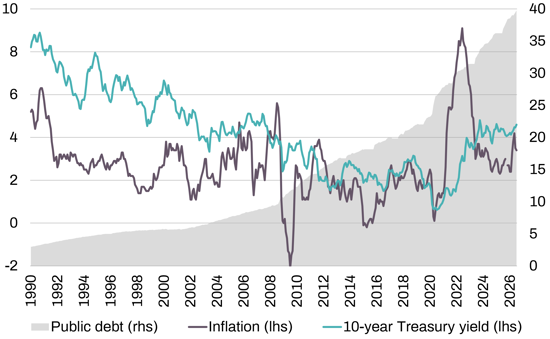
Public debt in $ billions, based on outstanding stock of US Treasuries. Inflation in % YoY based on consumer price index. Treasury yield in %. Monthly data. Sources: US Treasury, BLS, Federal Reserve Board


