
14 May 2026
UK GDP grew by 0.6% QoQ in 1Q26, matching consensus expectations, with household spending and business investment providing solid support, though net trade remained a drag.
Despite a strong start to the year, momentum has likely faded in the second quarter due to energy market disruptions from the Iran conflict, rising inflation, and renewed pressure on the housing sector.
- UK GDP expanded by a solid 0.6% QoQ in 1Q26, in line with Bloomberg consensus. Growth in the first quarter accelerated from a weak 0.2% in 4Q25, underpinned by healthy gains in household consumption and business investment.
- Data for 2025 has been revised in the latest release, including an upgrade to 4Q25 from 0.1% QoQ to 0.2%. These revisions partly explain the upside surprise in the YoY print for 1Q at 1.1%, versus 0.8% predicted by consensus.
- Looking at the details for 1Q, private consumption rose 0.6% QoQ, government spending grew 0.4%, and business investment advanced 0.7%, though overall capital spending still declined 0.6%; net trade was a drag, with exports edging up 0.1% and imports rising 0.6%.
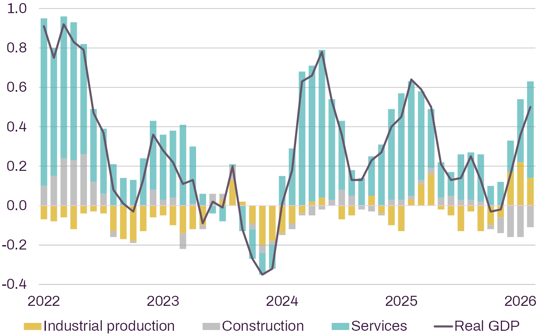
- Monthly data showed GDP rising 0.3% MoM in March, driven by a 0.3% gain in services and a strong 1.5% surge in construction, while industrial production fell 0.2%.
- Despite the encouraging start to the year (Figure 1), survey data as well as anecdotes from businesses indicate that momentum has softened through the second quarter amid supply disruptions in energy markets linked to the Iran conflict – which has pushed up benchmark interest rates and depressed confidence.
- For instance, the closely watched RICS housing survey, published today, showed a slump in price expectations in April. The headline house-price balance deteriorated sharply from -25% in March to -34% in April, missing Bloomberg consensus forecasts of -25% by a wide margin. Fresh inflationary pressures linked to the Iran conflict have pushed interest rates higher, placing renewed strain on an already fragile UK housing sector.
- The near-term outlook is further darkened by the risk of a noisy leadership contest in the Labour Party, which may lead to the ousting of Prime Minister Keir Starmer; to be replaced with a leader who is further to the left – raising the prospect of even more damage to growth potential coming from excessive regulatory policies and further tax rises to fund an ever-more bloated public sector.
- At the start of the year, we had projected that UK real GDP would expand by 1.3% in 2026. But emerging risks have weighed badly on the outlook and we have cut our forecasts in line with broader downgrades across the market for advanced economies. Our current 0.8% projection for UK GDP in 2026 is in line with consensus.
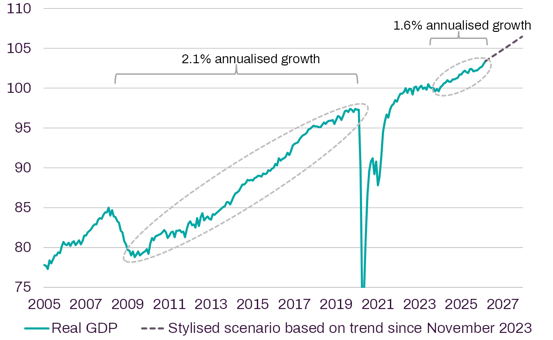
- Risks to our 2026 call are tilted to the downside. Over summer, we expect growth to slow to a crawl as rising inflation towards 3.5–4.0% YoY erodes real momentum. Looking further ahead into next year, beyond the Iran war and short-term political noise, we expect UK growth momentum to return to close to its post-pandemic trend of around 1.6% (Figure 2).
|
Figure 1: UK gross value added by sector |
|
|
|
3M/3M % change. Real terms. Sector contribution in percentage points. Monthly data. Source: ONS |
|
Figure 2: UK real GDP is on a slower trend than before the pandemic |
|
|
|
2023 = 100. Monthly data. Source: ONS |
View full notes


