18 March 2026
-
The Iran conflict has triggered major disruptions to global energy and trade, with markets remaining calm on hopes of a short war - but risks of severe shortages and stagflation rise as the conflict persists.
-
Geopolitical tensions are heightened, with the crisis challenging the dominance of the petrodollar and exposing fractures between the US, its allies, and China’s growing influence.
-
The crisis may evolve through three stages: (1) initial supply shocks which mostly show up as temporary price effects, (2) deeper economic impacts, and (3) potential financial market instability.
As the escalating war in Iran threatens a historic shock to global energy markets and trade, financial markets remain mostly calm. Yes, risk assets, including equities and bonds, have sold off, while commodity prices have spiked. However, markets are not trading as if major economies could be on the cusp of a severe bout of stagflation.
Could it be that markets are simply reflecting a collective wisdom that the global economy will muddle through yet another noisy crisis? Unlikely, in our view. After all, there is little disagreement regarding the potential seriousness of the problem.
Strikes by the US and Israel, and retaliatory attacks by Iran, have disrupted around one-fifth of global hydrocarbon supplies. They have also throttled a host of other critical industries that rely on the Middle East for energy and as a key hub for manufacturing. For the global economy, this threatens to be an even more serious supply shock than the Russian invasion of Ukraine in 2022.
In my view, the degree of calmness in markets reflects a combination of two factors. First, an assumption that the war will be over soon and that a protracted conflict remains a tail risk. Second, and related, investors and analysts believe that the impact of a protracted war is simply too serious to fully contemplate – and Washington knows this. Hence, before the global economy goes over the edge, the US will ensure it takes an off-ramp.
A short-lived conflict remains our base case. We recently downgraded our still-constructive outlook for global economies some two weeks ago on this assumption. See Growth down, inflation up: assessing the impact of the Iran war. Since then, however, because more time has elapsed without de-escalation, downside risks to global growth and upside risks to inflation have grown appreciably.
Commercial inventories and floating energy storage may provide a three- or four-week buffer before widespread shortages emerge. As a best guess then, that probably leaves just two, or maybe three, more weeks before the global economy and markets show serious strain. If markets eventually see sharp economic losses due to shortages as inevitable, and suddenly reappraise the outlook based on much worse assumptions about the length of the conflict, a more aggressive sell-off could unfold.
Not just an energy story
Iran has paralysed transit through the Strait of Hormuz, leading to the halting of major production and trade of energy supplies in the Middle East. This is despite efforts by President Trump and international allies to unblock the route or find a viable workaround. Note: a small number of ships, including Iran’s own as well as some from India and China, are periodically passing through the Strait.
The unfolding energy crisis is front and centre of all major news reports on the war. However, the Gulf region’s significance for the global economy extends far beyond oil and gas markets. It also serves as a crucial hub for the processing and export of raw materials, including fertilisers, aluminium, helium, sulphur, and petrochemicals. As a result, the disruptions are severely impacting supply chains worldwide. Shortages across a host of key inputs threaten global transportation, manufacturing, and food production. Even if the disruption ends soon, restarting idle plants and catching up on delayed shipments may take weeks. LNG flows face even more persistent risks – the restarting of complex liquefaction trains after shutdowns can take months.
The crisis underscores why past administrations in Washington have taken such a circumspect and cautious approach to Iran. It also shows that even the world’s most powerful country, the US, has no real power to control critical chokepoints in the global economy.
Three stages of a supply-side shock
The big question facing markets and economies is whether the shock will be temporary or structural. If the shock is temporary, the disruptions will largely remain technical and first order. Higher war premiums, more costly energy, and a sharp temporary jolt to production and trade flows will lift inflation and slow growth for a while, but should not fundamentally change the global growth outlook over the coming years. These first-order effects are already real and visible.
The International Energy Agency (IEA) has already authorised the largest coordinated strategic reserve release in its history. However, this does not fully offset daily losses from the disruption in the Gulf and acts only as a temporary measure to buy more time.
If the war becomes protracted, and the shock morphs into a structural one, it would produce second- and third-order effects that accumulate over time. Indeed, some second-order effects have already started to emerge. For instance, a number of Asian chemical producers and refiners have declared force majeure due to shortages and supply disruptions.
As the war goes on, declines in production, as well as outright shutdowns, will grow more numerous. This will harm revenues and profits, and threaten more serious costs to output, inflation, and employment.
As second-order economic costs grow, third-order effects may emerge in credit and financial markets. Banks may struggle to price loan risk, pushing up interest rates and harming valuations, and weakening credit flows. When businesses cannot generate the revenues to make payments on credit, that is when things can turn ugly fast. Tight credit conditions impair the critical buffers and flows of income that grease the wheels of commerce. In a worst-case scenario, financial markets could be engulfed by overlapping worries about private credit, AI disruptions, and the Middle East conflict.
Mind the petrodollar - geopolitical complexities make for difficult scenario planning
No economy is more strategically independent than the US. It produces surplus energy and benefits from a massive industrial base and deep reserves of key commodities. The US can tolerate a short-lived conflict, with any temporary increase in fuel prices for domestic consumers mostly offset by higher revenues and profits for its massive energy industry.
However, a short war assumes either one of two things happens. First, that Iran capitulates after the US has inflicted sufficient damage on its military assets that it can no longer pose any serious retaliatory threat. Alternatively, if the Islamic Republic is genuinely threatened, its regime leaders may try to negotiate a deal to ensure their survival. Second, Trump—with an eye on the November midterms—may try to call a victory on his own terms before the economic and financial cost to the US becomes so severe that it risks lasting political damage.
For now, neither side is showing any willingness to back down. The regime in Iran appears secure and, even accounting for reports of serious military losses, can pose enough of a threat via cheap and agile drone capabilities to keep shipping flows through the Strait of Hormuz disrupted. In the US, meanwhile, the relative calm of financial markets is giving the Trump administration breathing space to keep up the pressure.
Unless option one plays out and the US secures a victory soon, then option two may become the base case for markets. However, the US deciding when the war is over assumes it has that ability in the first place. Put differently, even if the US and Israel cease their attacks on Iran, can we be entirely confident that Iran would, in turn, stop its retaliatory attacks and its efforts to disrupt energy markets and global trade?
The US’s objectives are somewhat unclear. They range from Trump’s own maximalist claim that Iran names a leader whom he approves, to Secretary of State Marco Rubio and Defence Secretary Pete Hegseth emphasising more tactical military goals, which could offer some off-ramp opportunities. Conversely, Iran is single-mindedly aiming for regime survival. If that happens, especially after both the US and Israel had previously stated regime change as a war aim, it would represent a de facto win for Iran.
Iran may thus be inclined to push for a protracted conflict in which it is the architect of severe and lasting disruption, with the intent to establish sufficient deterrence against any future attacks. On a recent trip to the US, one client said to me, “the US is at war with Iran, but Iran is at war with the Treasury market.”
One argument against the ‘Iran might not stop’ view is that, if the US and Israel wish to genuinely end the war, then China—which has major economic interests at stake in the Gulf—would apply pressure on Iran to force an end. However, it is also worth leaning back and considering China’s calculus and interests.
Although the short-run costs of the war to China could be high, it would likely be a beneficiary from any reshaping of Middle East geopolitics. Note, for instance, the potential implications of reports earlier this week that Iranian officials have said the Islamic Republic may grant safe passage to oil tankers through the Strait of Hormuz if the cargo is traded in Chinese yuan.
If such reports are true, it could have huge implications for US–China politics and the importance of the so-called ‘petro-dollar’. For decades, Gulf energy producers have sold their product in US dollars, the global reserve currency. As these dollars are recycled back into the US economy via purchases of assets like US Treasuries and equities, the US enjoys growth-enhancing benefits from ever-rising stock markets and sustained massive Federal borrowing. However, if more global trade in energy occurs in Chinese yuan, it would not only serve Beijing’s desire for the yuan to become a major global reserve currency, but would also partly challenge the US economic model – helping China to close the gap.
Meanwhile, the Iran war seems to be driving a wedge between the US and its allies, who are refusing to meet Trump’s demands to help the US reopen the Strait of Hormuz. These dislocations in the western alliance are happening just as China steps up its diplomatic charm offensive with key US allies like Canada and the UK.
Do not expect much from central banks this week
Money markets expect all three major western central banks to keep rates unchanged when they meet this week – in line with our own view. Today, the US Federal Reserve (Fed) will publish its decision and, tomorrow, the European Central Bank (ECB) and the Bank of England (BoE) will publish theirs. The meetings come in the wake of money markets drastically raising their expectations for policy rates in the wake of the Iran war (see chart).
In the US, markets now look for two more Fed cuts over the next two years, down from three before the war. In the Eurozone, markets expect the ECB to hike at least once in the next year, up from no change before. In the UK, money markets see risks for the next year skewed towards a hike, compared to pricing in two cuts in late February.
The different market reactions for the ECB and the BoE (shifting towards hikes) and the Fed (still expecting cuts, albeit fewer) probably reflect two factors. First, the US is less sensitive to energy prices and imports than Europe, hence the inflation risks will be lower. Second, the dual-mandate Fed will be able to justify cuts in order to support its employment objective, and so can tolerate a little more inflation compared to single-mandate (inflation) central banks in Europe.
In my view, it is premature to expect either the BoE or the ECB to lean into this crisis with rate hikes. While such supply shocks pose challenges for central banks, uncertainty is much too high right now to argue strongly for any decisive policy change or for policymakers to even signal a potential response.
The market’s memory of the Russian gas shock of 2022, when both central banks slammed the brakes to curb inflation, still looms large. However, this time is somewhat different.
On the supply side, the current problem stems directly from the military conflict and ensuing disruptions, not the permanent and self-imposed sanctions that major economies placed on Russia since 2022. Chances are, Gulf energy production and shipping will resume once the fighting ends, and perhaps even before that if the Strait of Hormuz is partially reopened and other infrastructure comes back online.
Likewise, demand-side momentum in Europe looks weaker than four years ago. On the eve of the Russian invasion in February 2022, the European economy was running much too hot on the heels of excessive monetary and fiscal stimulus that policymakers had delivered during the 2020–2021 pandemic.
Unlike in 2022 and 2023, when inflation surged to double-digit rates but output merely stalled, the result today in the case of a protracted war would be an intense supply shock that runs up against much weaker demand growth. This tilts the risks towards larger output losses with a significant, but smaller, inflation spike.
For this week’s meetings, however, expect policymakers to avoid sending any strong signals about potential policy changes. Like markets, policymakers will probably assume (and hope) that the conflict will be short-lived. In that case, as soon as the war is over money markets will probably shift their expectations for central bank rates to close to where they were shortly before it started.
Figure 1: Money Market expectations for central banks
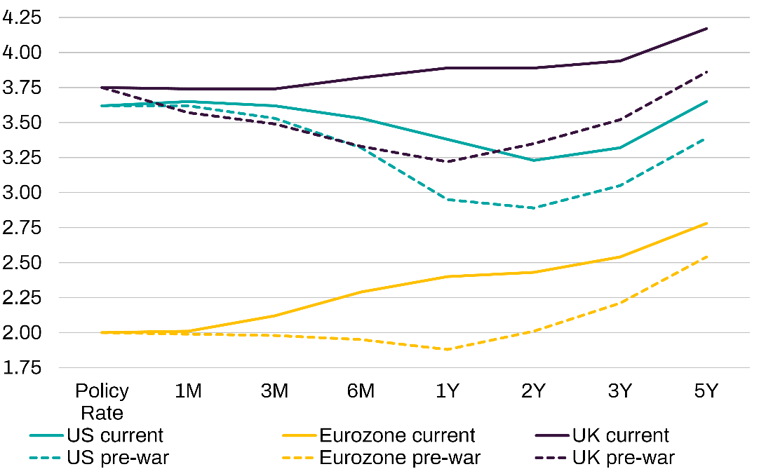
In %. Pre-war data based on 27 February 2026 data. Chart shows Federal Reserve mid-point of funds rate corridor, ECB deposit rate and BoE bank rate. Source: Bloomberg


