20 May 2026
- UK inflation data for April came in well below market expectations: easing the pressure on the Bank of England (BoE) to react to Iran-related energy price rises with a policy tightening.
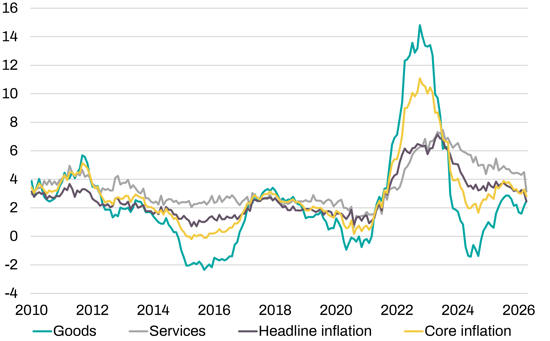
- Headline inflation slowed from 3.3% YoY in March to 2.8% in April, well below Bloomberg consensus expectations of 3.0%. On a MoM basis, prices rose by 0.7%, below consensus bets of 0.9% (Figure 1).
- Measures of underlying price pressures also cooled by more than consensus had predicted. Core prices, which strip out volatile energy, food and alcohol, slowed from 3.1% YoY to 2.5%, versus 2.6% expected, while domestically-oriented services prices slowed from 4.5% to 3.2% (3.5% expected).
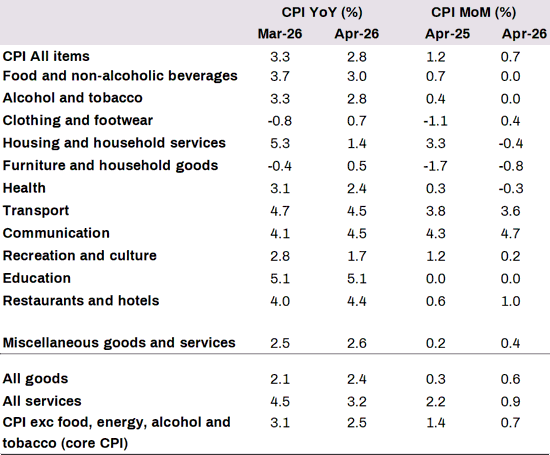
- Figure 2 breaks down changes in the consumer price index by key category. Transport costs, driven by a sharp rise in motor fuel prices caused by the Iran war, and communications made the largest upward contributions to the monthly rise in the consumer price index. Beyond those categories, however, prices either declined on the month, stayed flat, or rose modestly – indicating a lack of the kind of broad-based cost pressures that would typically concern policymakers at the BoE.
- Looking ahead, headline inflation is likely to creep higher over the summer – probably towards a c.3.5% yoy peak, as the Iran shock washes over the economy. However, we do not expect to see significant spillover or second-round effects - unlike in 2022 when the Russian-gas shock amplified inflationary pressures in an already-overheating economy. As we argued last month in our note 'The cautious case against BoE rate hikes' (see below), the UK appears to be on a decidedly disinflationary trajectory. With any luck, the positive inflation surprise in the April data will be the first of several over coming months.
- Upside risks to markets from here? We struggle to see how the BoE can or will hike rates given the current stream of data. We thus stick with our call for the BoE to hold over the summer, which sounding hawkish to acknowledge inflation risks, before cutting twice in 4Q26 once such risks have subsided.
- Naturally, at times like this, investors are prone to focus on downside risks – but some upside potential seems to be emerging too. If markets also start to see too much risk premium in UK gilts due to somewhat overblown domestic policy worries, combined with a BoE rates repricing towards fewer hikes, this could underpin a positive re-rating in gilts that would lift UK risk assets.
- Later today, BoE Governor Andrew Bailey and three of his fellow rate-setters will appear before Parliament’s Treasury Committee. They will offer their assessment of how the disruptions coming from the Middle East could impact the economy and prices.
Economic impact of the Iran war: The cautious case against BoE rate hikes
- The global supply shock emanating from the Iran war and the closure of the Strait of Hormuz poses serious downside risks to UK output and employment, as well as upside risks to inflation.
- While money markets expect the Bank of England (BoE) to lean against inflation risks with rate hikes in 2026, we see this as only a risk scenario. Instead, our base case is for the Bank to hold rates steady through the summer, before cutting in late 2026 once price pressures subside.
- Unlike following the 2022 Russian gas shock, when the BoE tightened policy aggressively to curb escalating inflationary pressures, the current domestic environment is characterised by softer aggregate demand, less underlying inflation momentum, and tighter financial conditions. This reduces the risk of a prolonged inflation spiral, increases risks to output and employment, and alters the BoE’s reaction function.
|
Figure 1: UK inflation and key price categories |
|
|
|
In % YoY. Core inflation (ex. energy, food and alcoholic beverages and tobacco). Monthly data. Source: ONS |
|
Figure 2: CPI Inflation by major sub-component |
|
|
|
Source: ONS |